Private Lender for Retail Businesses
Finance that moves at the speed of a stock order



Experts in strategic, short-term secured finance

Secured Lending is a private, non-bank lender. We fund retailers from $250,000 to $10,000,000, secured by a first or second mortgage over property. Most retailers lease their shopfront, so the security is almost never the store. It is the director's home or an investment property, and that is the standard, entirely fundable structure in private lending. Retail runs on one hard timing problem: stock has to be bought and paid for months before it sells, and the biggest stock order of the year lands right before the biggest trading period of the year. A bank serviceability model reads that gap as risk. We read it as timing, and because we lend our own funds and hold our own credit authority, a complete enquiry gets a decision in hours.
Who We Help
- Retailers on a leased shopfront whose director owns a home or an investment property, which is the usual security structure here and not a weakness in the deal
- Independent stores and multi-site operators funding a stock order well ahead of the season that sells it
- Seasonal and Christmas-weighted businesses carrying a full year of cost against a few concentrated trading weeks
- Owners fitting out a new store, refreshing a tired one, or taking on a second location
- Franchisees buying into a network, renewing a term, or acquiring a second territory
- Retailers whose margins have been squeezed by suppliers and landlords while the rent and the wages stayed exactly where they were
- Businesses carrying an ATO debt that is compounding while stock sits on the floor
- Directors with real equity in property who have been declined on servicing despite a viable store
How We Can Help You
- We lend against the director's home or investment property, so a leased shopfront does not stop the deal
- We assess the security and the exit, so a lumpy trading line or a thin margin is not what kills the application
- We hold our own funds, so a decision takes hours and settlement can happen within 24 hours
- We take a first or second mortgage, so an existing home loan does not have to be broken to release capital
- Terms run from 1 to 24 months, and most retailers are with us for 3 to 6 while the stock sells through
- Rates start from 9.7% p.a., interest only for the term
Retail Finance Scenarios We Fund
Retail lending is not one product. Funding a container of stock is a different structure to buying a second site or clearing an ATO position. Below are the scenarios we are asked for most often.
Stock and inventory
A supplier wants a deposit now and the balance on shipping. The container lands, the floor fills, and the money comes back over the following months as the stock sells through.
The order goes in on the supplier's timeline, so the shelves are full when the customers arrive rather than a season late. The facility is sized to carry the stock from purchase order to till, which makes it short by design, and the repayment already sits inside the trading cycle the stock was bought for.
- Funds deposits, balance payments, freight and duty
- The order is placed when the supplier needs it, not when the cash catches up
- No security taken over your stock or your debtor book
- Sized to carry the stock from purchase order to till
- Suits a container order, a bulk buy, or a line you cannot be out of
- Exit is the sell-through, or a refinance to a trade facility
Seasonal and Christmas trade
The Christmas order is placed mid-year, paid for in spring, and recovered in a few concentrated weeks of trade. The same shape applies to back to school, Easter, end of financial year and the winter or summer range, depending on what is being sold.
You go into the peak stocked and staffed, and the term is set to land after the trade that repays it rather than in the middle of it. Income that arrives in one short window is the normal case in retail, and the facility is built around that rather than against it.
- Covers the peak stock buy and the extra casual wages behind it
- The floor is stocked before the rush, not restocked after it
- Term set to run past the trading period, not into the middle of it
- The biggest order of the year is paid for before the biggest weeks of the year
- Suits Christmas, back to school, Easter and the seasonal range
- Exit is the post-peak trading proceeds
Fit-out and expansion
A fit-out is paid for in full before a single sale is made. A landlord contribution arrives late or not at all, the shopfitter wants progress payments, and a new site sits dark while the rent clock has already started.
The fit-out is finished before the season rather than during it, and the second store opens this year instead of next. The build runs to the shopfitter's program, not to whenever the incentive is paid, and the exit is the trading income once the doors open, or a refinance once there is a history to show.
- Funds shopfitting, plant, signage, POS and opening stock
- The doors open on the date the lease was signed for
- Progress payments are met without waiting on a landlord contribution
- Rent is being paid on a trading store, not a dark one
- Suits a first refurbishment or a second site
- Exit is trading income, a landlord contribution, or a bank refinance
Franchise
A franchise purchase runs to a contract date. The franchisor wants the fee, the vendor wants settlement, and the territory is not held open while finance is arranged. A term renewal or a second territory carries the same deadline pressure.
The territory is yours on the contract date, because we work to the settlement the franchisor and the vendor set. The exit is a refinance to a franchise lender once the store has trading history, or the sale of another asset where that is the plan.
- Funds the franchise fee, the goodwill and the initial stock
- Settlement is met on the contract date, so the territory holds
- A renewal fee is paid before the term lapses
- Suits a first store, a renewal, or a second territory
- Lending to Pty Ltd companies and family trusts
- Exit is a refinance to a franchise or bank facility
Bridging finance
A lease is on offer in a better centre, a competitor is selling their site, or a wholesale parcel is available at a price that will not be there next month. The money that funds it is coming, from a sale, a settlement or a season, but it is not here yet.
You take it at the price it was offered at, not the price it becomes once the offer expires. The incoming funds are the exit, and the facility exists only to close the gap between a cost that falls due now and the money that was always going to cover it.
- Covers the gap between a commitment now and funds arriving later
- The clearance line or wholesale parcel is bought at the price offered
- Caveat loan available where the window is genuinely days
- Repaid in full as soon as the incoming funds land
- Suits a better centre, a competitor's site, or a one-off buy
- Exit is a property settlement, a business sale, or a season
Refinance
Banks have tightened on retail, and the fallout lands on operators who have done nothing wrong. An overdraft limit is cut mid-year, a facility is not renewed, or an annual review arrives just as the peak stock order is being placed. Nothing about the store itself has changed.
You get the timeline back. The facility takes out the expiring lender or the expensive short-term debt already on the books, and the move to a longer-term lender then happens on a schedule the business chooses rather than one it is handed.
- Refinances an expiring, reduced or non-renewed facility
- Consolidates high-cost merchant advances and revenue-based debt
- The peak stock order still goes in while the review is running
- The store keeps trading while the position is restructured
- Suits an overdraft cut mid-year, or a limit that was not renewed
- Exit is a refinance to a longer-term lender, or a sale
ATO tax debt
ATO debt attracts penalty interest that compounds, and recovery action does not wait for the stock on the floor to sell. Once a payment plan is broken the pressure escalates quickly, a director penalty notice can follow, and suppliers start hearing about it before the owner does.
The escalation stops. The balance is cleared in a single payment and the business repays from trade over a short, defined term.
- Clears the ATO balance in one payment
- Stops penalty interest compounding
- Suitable where a payment plan has already been broken
- Suits a director penalty notice already on the table
- Suppliers and landlords keep dealing with a business that is trading
- Exit is trading income, a season, or a bank refinance
Working capital
Margin gets squeezed from both ends. Suppliers lift their prices, landlords lift the rent, and the price on the shelf can only move so far before customers walk. The rent, the wages and the supplier accounts keep falling due in the quiet months regardless.
The doors stay open through the quiet quarter and the staff are paid, so the business reaches the next peak with stock on the floor instead of a hole in it. The facility is short by design and repaid out of the trade it made possible.
- Covers rent, wages, supplier accounts and BAS
- The doors stay open through the quiet quarter
- The next peak is met with stock on the floor, not a gap on it
- A second mortgage sits behind an existing home loan, which does not have to be broken
- Suits a squeeze between a supplier price rise and a rent review
- Exit is the next trading period or a refinance
Our Loan Products
- First mortgage: the cleanest position, used where the director's property is unencumbered or an existing loan is being refinanced in full
- Second mortgage: sits behind an existing first, so a home loan and its fixed rate stay untouched while equity is released for stock or a fit-out
- Bridging loans: covers the gap between a cost that is due now, such as a stock order or a lease deposit, and the income or settlement that repays it
- Caveat loans: our fastest product, lodging a caveat rather than registering a full mortgage, for genuinely urgent windows such as a supplier deadline or a franchise settlement
Related Reading
- →Private lender for retail business finance
- →Private lender for inventory and stock finance
- →Bridging finance for retail store expansion
- →Caveat loan for urgent inventory funding
Bad Credit Finance for Retailers
A retail credit file records every soft quarter, and one of them can leave arrears that follow you for five years. We lend against the property behind the business, whether that is the trading premises or a home owned by a director, to 70% LVR. What we assess is the equity and the exit. Defaults on file are ordinary here.
"Almost every retailer who calls us assumes a leased shopfront rules them out. It does not, and it never has. What matters is that the stock gets bought at the price it was offered at, and that the shelves are full when the customers arrive, not in January once the season has gone."

Gino Tabila
Associate Director
Recently Asked Questions
Get an indicative offer within hours, not weeks.
No credit check. No obligation.
Why Secured Lending?
Are you a broker? Find out why brokers love working with us.
Case Studies
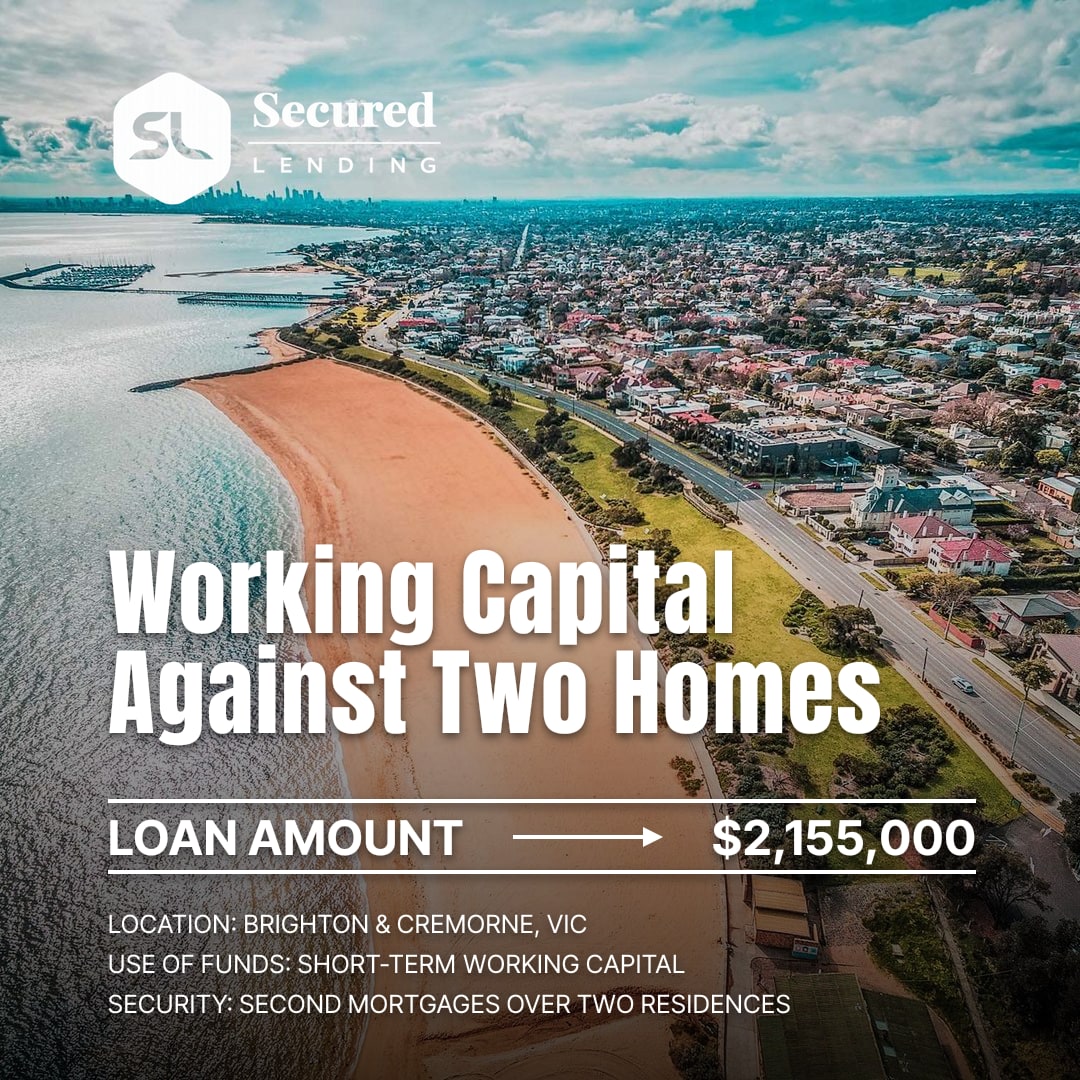
$2.155M Second Mortgage Working Capital Facility Across Brighton and Cremorne

$280K Second Mortgage for Short-Term Cash Flow in Kooyong

$545K Bridging Loan Across Three Suburbs in Melbourne's North-West

$400K Second Mortgage Repaid in Full After a Flexible Two-Month Extension

$1.8M First Mortgage Releases $980K of Working Capital for a Solar Business

$2.3M Second Mortgage Refinances an 18% Facility for a Glass Manufacturer

$800K Bridging Finance for Simultaneous Property Transactions in 48 Hours