



An important decision in mortgage fund investing is often not which fund to choose. It is which structure. Pooled or contributory. That choice determines whether your money is spread across many loans or concentrated in one, how much you can see, and how much you control. Most investors do not understand the difference before they commit, and it shapes their risk more than the headline return does.
This guide explains how pooled mortgage funds work in Australia, how they compare to contributory funds, where pooling protects you and where it does not, and what to check before you invest. Our own SL Premium Income Fund gives wholesale and sophisticated investors both pooled and contributory access to first-mortgage lending, and we draw on it through this guide to show how the pooled structure works in practice.
What a pooled mortgage fund is
In a pooled mortgage fund, your money sits across a portfolio of loans rather than in a single one. You do not select individual deals. The manager builds and runs the loan book, and you receive a share of the blended income it generates, less fees and costs.
The structure is a unit trust. You hold units in a pool, the pool holds many loans secured by mortgages over property, and your income reflects the performance of the pool as a whole. You are buying exposure to a diversified book and to the manager's judgement in assembling it.
The trade is straightforward. You give up deal-by-deal control and transparency. In return, you get diversification across many loans and far less work. Whether that trade suits you depends on what you value, which is the heart of the pooled versus contributory question.
Pooled versus contributory: the core distinction
These are the two structures in mortgage fund investing, and they sit at opposite ends of a spectrum between convenience and control.
In a contributory fund, you choose the specific loan or sub-trust you invest in. You see the security, the loan-to-value ratio, the borrower profile, and the term, and you make the call. You get full transparency and control over each exposure. The cost is effort, because you must assess each deal, and concentration, because your capital may sit in a single loan with a single borrower.
In a pooled fund, the manager allocates your capital across the book. You give up the ability to pick deals and the line of sight into each one. In return, a single borrower default is absorbed across a diversified pool rather than landing entirely on you, and you do not have to underwrite each loan yourself.
Neither is better in the abstract. A contributory structure suits an investor who wants to see and control every exposure. A pooled structure suits an investor who wants diversification and simplicity and is willing to rely on the manager to deliver it. Our first mortgage investment funds guide and private mortgage funds guide go deeper on the security behind both approaches.
It is worth noting that Australian regulation recognises this distinction. In ASIC's Regulatory Guide 45, which governs disclosure for mortgage schemes offered to retail investors, the loan portfolio and diversification benchmark applies specifically to pooled mortgage schemes. Diversification is treated as a defining feature of the pooled model, not an optional extra.
How pooling spreads risk, and where it stops
The central benefit of a pooled fund is diversification. If one loan in a large pool defaults, the loss is shared across the whole book and diluted, rather than wiping out a single concentrated position. For an investor who would otherwise have all their capital in one loan, this is a meaningful reduction in risk.
The limit is just as important, and honest managers state it plainly. Pooling diversifies the risk of any single loan failing. It does not remove the risks that hit the whole book at once. A downturn in the property market, a regional shock, or a sector-wide stress affects every loan in a pool that lends against the same kind of security. This is concentration risk at the portfolio level.
We are direct about this in our own Information Memorandum. The fund focuses on commercial loans in the property sector only, which is not diversified across different sectors, and some loans may be advanced to a single borrower or related entities where our loan standards are met. A pooled mortgage fund spreads single-loan risk. It is still a concentrated bet on property. Understanding that distinction is what separates an informed pooled investor from a complacent one.
Income and withdrawals in a pooled structure
In a pooled fund, your income is a share of the pool's blended return rather than the interest from one identified loan. The objective of this asset class is regular income, paid monthly or on the frequency the fund specifies, not a capital gain on exit. Unit prices are typically fixed. In our SL Premium Income Fund, each unit is priced at $1.00.
Liquidity works the same way it does across this asset class, and it requires patience. These funds are illiquid, with no secondary market for units. Withdrawals run on the fund's terms, not on demand. In our SL Premium Income Fund, withdrawals are processed quarterly on the first business day of each calendar quarter, after a minimum holding period, with at least 30 business days' notice and a minimum of $100,000. Early redemption before the minimum holding period carries a 2 percent fee and is at our discretion.
We are also clear about what happens in stressed conditions. Where the value of income-generating assets in a sub-trust falls well below the capital invested, units may be redeemed on a pro-rata basis at our discretion, and investors have no recourse for any shortfall. This is the practical reality of a pooled, illiquid structure, and it should be understood before investing rather than discovered later.
The pooled model in practice: our money pool fund
Our structure is a useful, concrete example of how a pooled option is built, because we offer one within a wider set of sub-trusts.
Our SL Premium Income Fund is a unit trust with multiple sub-trusts. One of these is a "Money Pool Fund". When an investor places capital in the Money Pool Fund, we allocate that capital at our discretion across some or all of the other sub-trusts. The effect is exposure to a range of loans through a single allocation, rather than the investor selecting each one.
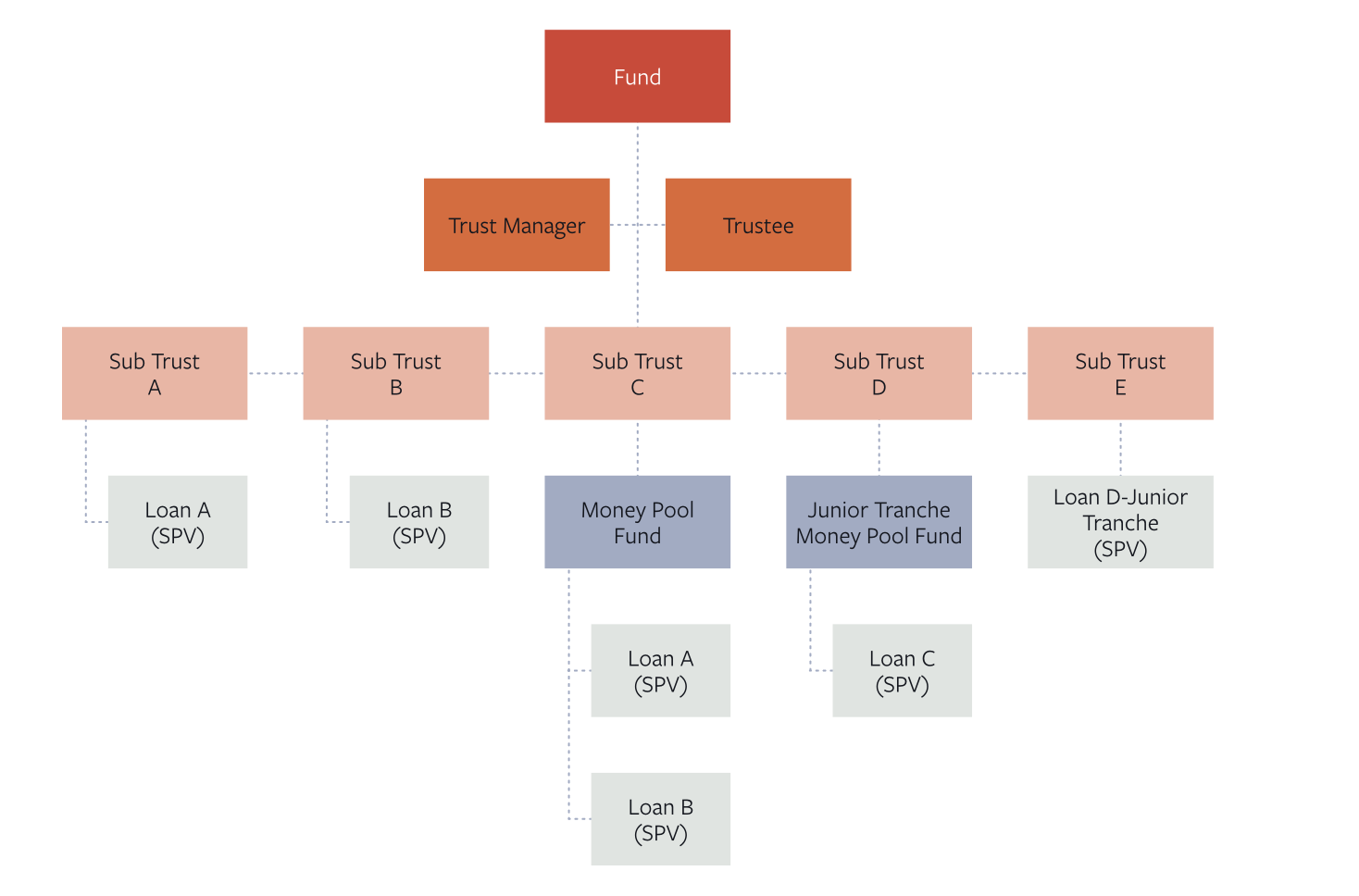
One caveat is important, and we state it plainly: we may allocate the entire amount to a single sub-trust. In other words, the pooled option permits diversification but does not guarantee it in every case. A serious pooled investor reads that caveat and asks how allocation actually works in practice, rather than assuming a pool is always spread. We are happy to walk you through how we allocate.
The hybrid advantage
Most mortgage fund managers offer one structure. They are either pooled or contributory. We offer both within the same fund, which is uncommon and worth understanding.
An investor in our SL Premium Income Fund can choose a specific sub-trust, which is the contributory approach, with visibility over that particular exposure. Or the investor can use the Money Pool Fund, which is the pooled approach, allocated across sub-trusts at our discretion. The same fund accommodates an investor who wants to select a single loan exposure and an investor who wants diversified exposure across the book.
That flexibility is a genuine structural feature rather than a marketing point. It lets you match the structure to your own preference for control or diversification, and it is the kind of option worth confirming exists, and on what terms, in any fund you consider.
The risks of pooled mortgage funds
Diversification reduces single-loan risk. It does not make a pooled fund risk-free. The risks that matter most are these.
Concentration and systematic risk. A pool that lends against one type of security, such as property, is exposed to a downturn that affects all of that security at once. Diversification within an asset class is not diversification across asset classes.
Manager discretion. In a pooled fund you delegate allocation to the manager. Your outcome depends on how the manager builds and runs the book, and, in a structure like our Money Pool Fund, on how capital is actually spread across sub-trusts.
Liquidity risk. No secondary market exists, withdrawals are periodic and subject to notice, and in stressed conditions redemptions may be delayed, suspended, or made on a pro-rata basis at the manager's discretion.
Valuation and credit risk. The value of the security behind the pool's loans drives recovery if borrowers default. Inflated valuations or borrower failure can reduce the pool's income and capital.
Transparency risk. By design you see less of each individual loan than a contributory investor does. That places more weight on the manager's reporting and on your assessment of the manager before you invest.
How to assess a pooled mortgage fund manager
Structure matters, but the manager matters more. Our companion guide covers the questions that actually matter when assessing a manager, and trustees investing through a self-managed super fund should also read what SMSF trustees need to know.
Because a pooled fund concentrates your reliance on the manager, the manager is the investment. Four checks matter most, and here is how we measure up against each.
Track record, with specifics. Look for real numbers on volume lent, number of loans, and capital losses. Since 2016 we have lent more than $500 million.
Recovery capability. A pool's resilience depends on how the manager handles the loans that fail. Our team includes Mark Hutchins, our Managing Director, with a background in insolvency, structured finance, and bank workout; Daniel Juratowitch, a registered liquidator and bankruptcy trustee of more than 20 years and CEO of insolvency firm Cor Cordis; and Robert Rowlands, a New South Wales registered valuer with more than 40 years of experience. Recovery skill protects every investor in the pool.
Allocation transparency. In a pooled structure, ask how capital is actually allocated, how concentrated the book can become, and, where a fund permits allocation to a single sub-trust, how often that happens. We are open about how our Money Pool Fund allocates.
Alignment. We settle loans with our own funds first under a pre-funded model, and where we co-lend, we are repaid only after the investor has been repaid in full.
The SL Premium Income Fund in brief
For wholesale and sophisticated investors, our SL Premium Income Fund offers both pooled and contributory access to first-mortgage lending. The detail below is summarised from its Information Memorandum dated 21 February 2024.
- •An unregistered managed investment scheme, structured as a unit trust with multiple sub-trusts, including a Money Pool Fund for pooled exposure.
- •Investors can choose a specific sub-trust (contributory) or the Money Pool Fund (pooled, allocated at our discretion, and able to be allocated to a single sub-trust).
- •Loans are secured by first registered mortgages over Australian real property, generally up to 70 percent LVR, with target terms generally under 12 months.
- •The fund targets 7 to 9.95 percent per annum, varying by sub-trust, with no guarantee of return or capital.
- •It is open to wholesale and sophisticated investors only, and is not available to retail clients. It is not a PDS product.
- •The minimum investment is $100,000, with units priced at $1.00.
- •The trustee is SL Premium Income Fund Pty Limited (AFSL 549857) and the trust manager is SL Group Management Pty Limited.
FAQs
What is a pooled mortgage fund?
A fund where your money sits across many loans rather than one. You do not pick individual deals. You receive a share of the blended income from the whole loan book, and a single default is absorbed across the pool.
Pooled or contributory: which is better?
Neither is better in the abstract. Contributory gives you transparency and control over each exposure, at the cost of effort and concentration. Pooled gives you diversification and simplicity, at the cost of control and transparency. Our SL Premium Income Fund offers both.
How does a pooled fund spread risk?
By holding many loans, so that one borrower's default is diluted across the book rather than landing on a single position. The limit is that pooling does not protect against a downturn that affects the whole portfolio, such as a fall in the property market.
Can I lose money in a pooled mortgage fund?
Yes. Pooling reduces single-loan risk but does not guarantee capital. Borrower defaults, falling property values, and sector-wide stress can all reduce income and capital. No return or capital is guaranteed.
How do withdrawals work?
These funds are illiquid with no secondary market. In our SL Premium Income Fund, withdrawals are processed quarterly, after a minimum holding period, with at least 30 business days' notice and a minimum of $100,000. In stressed conditions, redemptions may be delayed, suspended, or made pro-rata at our discretion.
Who can invest in a pooled mortgage fund in Australia?
Some funds are registered and open to retail investors. Others, including our SL Premium Income Fund, are open only to wholesale and sophisticated investors, which generally means investing at least $500,000, or holding a qualified accountant's certificate confirming net assets of at least $2.5 million or income of at least $250,000 for the last two financial years, or being a professional investor.
Invest with the SL Premium Income Fund
For wholesale and sophisticated investors, our private mortgage investment fund, the SL Premium Income Fund, offers both contributory and pooled access through the Money Pool Fund. You can also read more about the first mortgage income behind every loan, and how the fund provides exposure to alternative real estate debt.
This guide is general information only. It is not financial, tax, or legal advice, and it does not take account of your objectives, financial situation, or needs. Information about the SL Premium Income Fund is summarised from its Information Memorandum dated 21 February 2024; read the Information Memorandum in full for the complete terms. The Fund is open to wholesale and sophisticated investors only and is not a retail offer. Past performance is not a reliable indicator of future performance, and no return or capital is guaranteed. Seek independent professional advice before making any investment decision.